

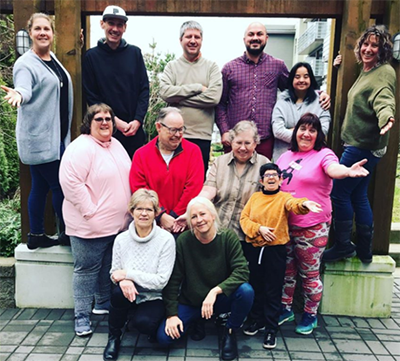
Pictured with members of the BC Self-Advocate Leadership Network, Arlene and Nolda (first row, left and right) emphasize the importance of supporting self-advocates to lead in their own ways.
What kind of support do self-advocacy groups want to be leaders? Members of this magazine’s Editorial Team said it is simple: “Walk beside us, or behind, but never in front.” We spoke to supporters Arlene Schouten and Nolda Ware to understand what this means.
“Yes, this is my rule too,” says Arlene, retired from a career in community inclusion and who had a daughter with diverse abilities. “I truly believe that all people are capable of directing their own lives. They have wonderful ideas but sometimes they are not seen in front.”
“It’s really believing in people leading their own movements in their own way,” says Nolda Ware, Manager of Family Support Services with UNITI, who has an older brother with developmental disabilities. “It’s about stepping out of the way – and that can be hard – and supporting them to lead.”
Sometimes, self-advocates say they do not feel they are taken seriously, and it requires a change in attitudes.
“I think they want to be seen as fully participating citizens in their community,” says Arlene, who supports the Mission Self Advocacy Group. She recalls a recent accessibility event organized by self-advocates on a local church parking lot. When community members saw self-advocates staffing their own booths and speaking on topics of concern from lived experience, there was a huge shift.
So how do you support self-advocates to be up front? Nolda shares about a recent request the Self Advocates of Semiahmoo received to speak to UNITI’s Board of Directors. “Okay, this is yours,” Nolda recalls telling the group. “What do you need to talk to the Board?”
Nolda says it was amazing to see them take it away, decide what they would talk about, and put it together and practice.
“If you have self-advocates lead, versus them just helping, you see the magic of the impact it has. People paid attention, they listened and they had a million questions. And an important outcome is that the Board acted on what they heard.”
Nolda says she supports them to gather plain language information, to consider multiple viewpoints, and to prepare and practice presentations.
When members of the public ask how to help, Arlene says it is all about education. “Often it is having those events and inviting them so they see self-advocates leading firsthand.”
Nolda agrees and says that learning is different for everyone. She has encouraged people to start by reading stories about the history of the self-advocacy movement, their experiences, and their leadership. Many can be found on the websites of Inclusion BC, Community Living BC and Self-Advocate Net, which is run by self-advocates.
“It’s about commitment and intention,” says Nolda. “Is it genuine and is it about really listening to them? It’s also about building a reciprocal relationship.”
The BC Self-Advocate Leadership Network has created a supporter profile describing how to provide support. To request this document, email SALNBC19@gmail.com.