

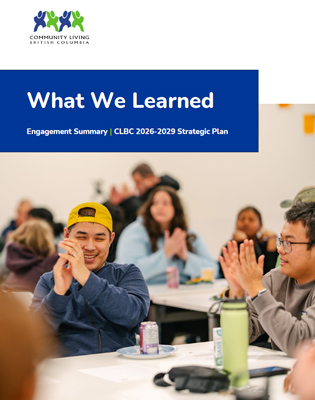
CLBC is currently creating our next strategic plan to help guide our organization for the next three years. Our new plan will be shaped by the voices and experiences of people with developmental disabilities who receive CLBC funded services, as well as their families and service providers. We just published a What We Learned report, to share back what we learned through our engagement process. The new strategic plan will be available in fall 2026.
To reach the people we serve, their families and other groups, we took a community-led engagement approach, which resulted in over 1,100 people providing feedback. It’s the largest engagement campaign ever for a CLBC strategic plan. There were 71 community-led engagement sessions across BC, a public survey and targeted reach outs. More than 350 self-advocates and nearly 350 family members took part in these sessions. CLBC is extremely grateful for the work of leaders from self-advocacy groups, our 12 Community Councils, the Indigenous Advisory Committee and community and Indigenous partners who led engagement sessions.
During the engagement there were seven themes that emerged. These themes are helping to inform CLBC’s new strategic plan and will guide how the organization sets priorities for the next three years
- Communication was the most important issue raised.
Across all groups, people said information from CLBC is sometimes hard to access, unclear, or not in plain language. People want proactive, consistent communication, provided in different ways. - People want to understand decision-making that affects them.
Clear, plain‑language explanations about eligibility and decision‑making help people understand who qualifies for services, why decisions are made, and why services are approved. This information supports informed choice, trust, and a stronger sense of fairness. - People want to feel seen and heard.
Relationships and presence matter. People want CLBC staff to know them and ask questions to better understand their situation. - A lack of role clarity creates confusion.
This includes CLBC’s role as an organization and the facilitator’s role as a main point of contact. People recognize that facilitators manage large and complex workloads but are often unclear about what facilitators can and cannot do. - Cultural supports are essential to health and wellbeing.
Indigenous participants and others emphasized that cultural identity and connection to culture helps people to feel a sense of belonging, safety, and healing. People called for Indigenous-led, culturally grounded supports to be built into services so the whole person is supported. They want CLBC to build connections with more Indigenous organizations and Nations and provide training to staff to advance culturally safe spaces. - The transition from youth to adulthood is especially challenging.
Families and people who receive CLBC services described this period of time as stressful and confusing, with major changes in support offered, system processes, and language used by different agencies. People want earlier, clearer, and more coordinated planning for this transition. - Stronger coordination and liaison across government systems is needed.Many people experience gaps between CLBC, health, housing, and other government services. Challenges include inconsistent language, limited plain‑language materials, and difficulty navigating multiple systems.
Read the full What We Learned report here.