

CLBC is proud to be part of the Global Leadership Exchange (GLE), a global network bringing together leaders in disability, mental health and related sectors to share knowledge and advance inclusive practices. As part of the 2026 Leadership Exchange, more than 30 Match events took place across Canada, giving participants opportunities to connect and exchange ideas ahead of the larger conference that happened in Ottawa from June 3 to 5.
Last month, CLBC’s Indigenous Advisory Committee hosted one of these Match events at the University of British Columbia. Titled Leading in Two Worlds: Indigenous Systems Change for Disability, Mental Health, and Community Well-Being, the two-day gathering brought together international delegates, Indigenous leaders, self advocates, families and sector partners to explore how Indigenous leadership is transforming systems through culture, relationships, lived experience and community-led approaches.
Match event day one
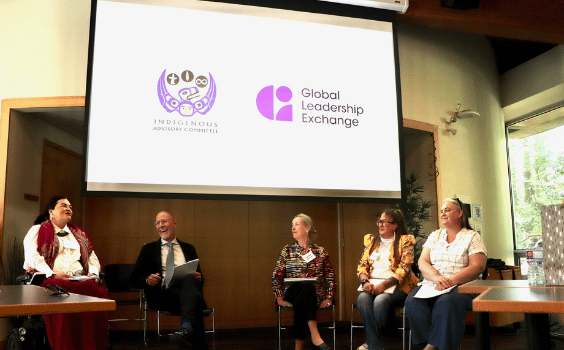
Panelists left to right: Ronelle Baker, Ministry of Disabled People; Indigenous Leader (Aotearoa New Zealand), Dr. Philip Klassen, Vice-President, Medical Affairs and Research, Ontario Shores Centre for Mental Health Sciences (ON Canada), Angélique Koevoets, CEO, Ipse de Bruggen (Netherlands), Delia Nolan, Executive Director, SAMS (New Zealand), Eilidh Nicholson, Coordinator, Spectrum Society (BC Canada).
The event opened with an introduction to CLBC’s Indigenous Advisory Committee (IAC), highlighting its role in advancing Indigenous-led systems change and strengthening community-driven decision-making across disability services.
Delegates from Canada, Aotearoa New Zealand and the Netherlands shared their experiences leading change within their own organizations and communities. Although their work takes place in different countries and systems, many reflected on common challenges and opportunities.
Throughout the discussions, a consistent message emerged: meaningful support begins with relationships. Panelists emphasized the importance of moving away from systems focused on risk, deficits and control, and toward approaches grounded in trust, culture and lived experience. Speakers also acknowledged the lasting impacts of colonization and institutional harm on Indigenous communities while highlighting that many solutions already exist within communities through cultural knowledge, storytelling, collective healing and self-determination.
Another panel explored the realities of advancing Indigenous leadership within Western systems, highlighting mentorship, relational accountability and preparing the next generation of Indigenous leaders.
Match event day two
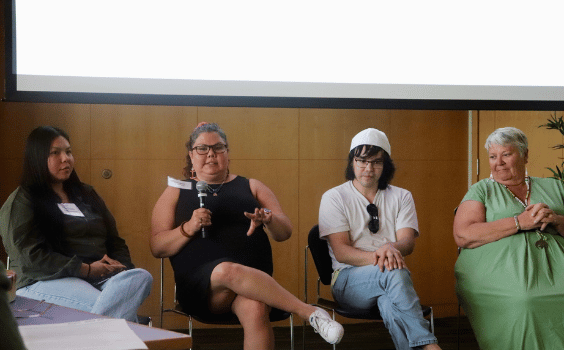
Panelists (left to right): Cheyenne Yellowhead, Spectrum Society, Lindsay Clifton, Spectrum Society, Sherwin Strong, Self Advocate / CLBC Advisor, Michelle Fortin, Métis Nation British Columbia.
The second day focused on the power of lived experience in shaping more inclusive systems. Self advocates and family members shared personal stories about navigating disability, mental health and community supports, offering both honest reflections on the barriers they continue to face and hopeful examples of what is possible when people receive the right supports.
Panelists spoke about challenges including delays in accessing services, difficult transitions into adulthood, inflexible funding models and the significant responsibilities often carried by families. At the same time, they emphasized that with culturally responsive, person-centred supports, individuals can thrive and build meaningful lives connected to their families, cultures and communities.
Participants also learned from leaders in Aotearoa New Zealand, who shared how Māori worldviews have shaped disability system transformation through the Enabling Good Lives approach, emphasizing self-determination, holistic wellbeing and community-led supports.
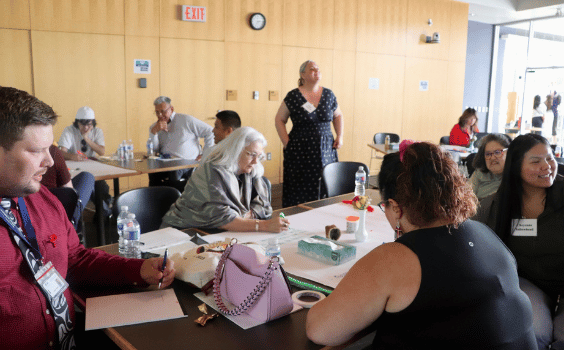
Participants taking part in the World Café conversation.
The event concluded with a World Café conversation, where participants reflected on key learnings and explored practical ways to strengthen partnerships and advance Indigenous-led systems change in their own communities and organizations.
By bringing together diverse perspectives from around the world, the Match event reinforced that lasting systems change is rooted in relationships, cultural knowledge and lived experience.
CLBC is proud to participate in the Global Leadership Exchange and to continue working alongside self advocates, Indigenous leaders and partners to strengthen relationships, advance Indigenous-led systems change, and improve outcomes for Indigenous people with developmental disabilities.
Photo credit: Thank you to Bremiella De Guzman, Indigenous Policy & Practice Lead, for capturing the photos featured in this story.